Screen Printing vs Heat Transfer vs Digital: Which Tote Bag Printing Method Is Right for Your Order?
If you are sourcing custom bags for your brand, one of the first decisions you will face is how your logo actually gets onto the fabric. Tote bag printing methods are not interchangeable — each technique changes the look, the feel, the durability, and the price of your final product. Choose the wrong one and you can end up with cracked artwork after three washes, a design that feels stiff and rubbery, or a cost structure that makes your wholesale order unprofitable.
This guide compares the three most common tote bag printing methods used by suppliers today — screen printing, heat transfer, and digital (DTG) printing — from the perspective of a B2B buyer. We break down how each one works, how long it lasts, how it feels, what it costs, and what minimum order quantities to expect. By the end you will have a clear decision framework you can hand to your account manager the moment you request a quote.
Why the Printing Method Matters More Than You Think
Your bag is a walking billboard. On a cotton tote, canvas carryall, or reusable shopping bag, the print is usually the entire reason a customer picks it up — or puts it back. Yet many buyers treat printing as an afterthought, only to discover too late that the chosen method doesn’t suit their artwork, their budget, or their order volume.
There are three reasons the printing decision carries real weight for procurement teams:
- It drives the unit price. Setup, plates, and labor differ dramatically between methods. A screen print on a 1,000-unit order can cost far less per piece than digital, while a 50-unit order flips the math completely.
- It determines how long the bag looks good. Some prints survive 50 industrial washes; others start peeling in week two. If your client is a grocery chain or a hotel giving bags to thousands of guests, durability is a brand-safety issue.
- It limits your artwork options. Photographic gradients, fine text, and full-color logos each have a “natural” method. Forcing artwork into the wrong process means visible quality loss.
Understanding the basics of each tote bag printing method is the fastest way to avoid these surprises, so let’s look at how each one actually works.
How the Three Tote Bag Printing Methods Work
Screen Printing
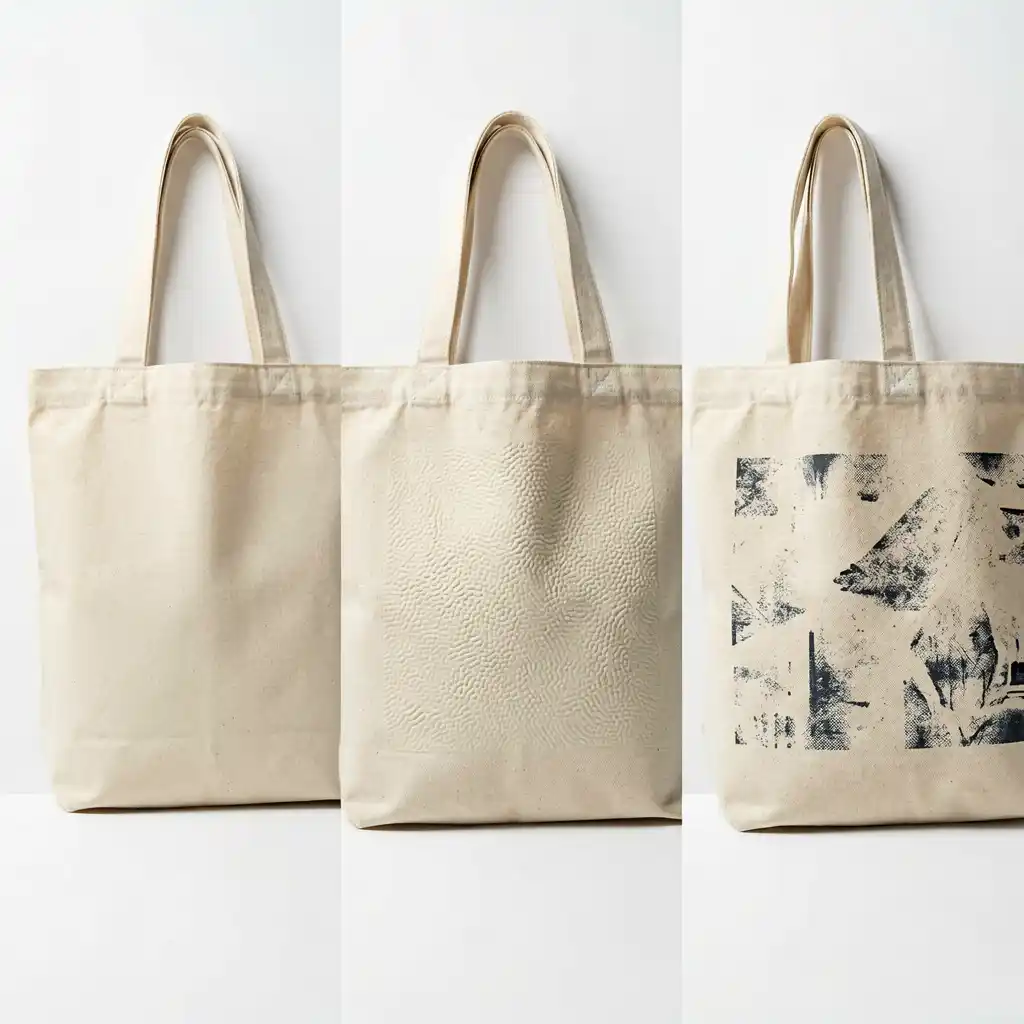
Screen printing is the oldest and most widely used of the three methods, and it is still the workhorse for most large B2B tote bag orders. The process starts with a fine mesh screen coated in a light-sensitive emulsion. Your design is exposed onto the screen, which hardens the emulsion except where the artwork sits, leaving an open stencil. Ink is then pushed through that stencil onto the fabric with a squeegee — one pass for each color.
Each color in your logo requires its own screen and its own pass through the press. A two-color logo needs two screens; a six-color design needs six. This is why setup costs rise with color count, and why screen printing rewards simple, bold, low-color artwork.
Heat Transfer (Vinyl / DTF)
Heat transfer covers a family of methods, but the two you will most often be quoted are vinyl heat transfer and DTF (direct-to-film). In both cases, the design is first printed onto a carrier material — a sheet of vinyl or a special transfer film — and then pressed onto the bag under high heat and pressure using a heat press.
Vinyl transfer is cut from solid sheets, so it is limited to solid-color shapes and lettering. DTF is printed full-color onto film and then transferred, which means it can reproduce gradients and photographs more easily. Because the design is created separately from the bag, heat transfer is fast to set up and works well for smaller quantities and last-minute orders.
Digital (DTG) Printing
Digital printing — or DTG, direct-to-garment — works like a high-end inkjet printer laying ink directly onto the fabric. The bag is loaded onto a flatbed, a pre-treatment is applied, and the machine sprays the design in full color, layer by layer. DTG prints directly from a digital file, so there are no screens, no plates, and essentially no setup cost.
This makes digital the obvious choice for photographic artwork, gradients, and very small orders. The trade-off is that it can be slower and more expensive per unit at scale, and the printed surface feels noticeably thinner than screen or heat-transfer ink.
Buyer note: When a supplier quotes a custom logo tote, always ask which process they recommend for your artwork and volume. The cheapest quote on paper may be the most expensive in cracked print and reorders.
Durability, Feel, and Color: Tote Bag Printing Methods Compared
This is the table your team will want to keep. It compares the three methods across the factors that matter most at the point of purchase — how long the print survives, how it feels to the touch, and how accurately it reproduces your colors.
| Factor | Screen Printing | Heat Transfer (DTF/Vinyl) | Digital (DTG) |
|---|---|---|---|
| Durability (washes) | Excellent — 30–50+ washes when cured properly | Good — 10–30 washes; vinyl can crack sooner than DTF | Good — 20–40 washes with proper pre-treatment |
| Hand feel | Soft, slightly textured; ink sits in the fabric | Raised, rubbery layer on top of the fabric | Very thin, almost like part of the fabric |
| Color vibrancy | Opaque, vivid; best on light and dark fabrics | Excellent full color; vinyl is flat solid colors | Full photographic color with smooth gradients |
| Fine detail / small text | Good but limited below ~1mm detail | DTF good; vinyl poor for fine detail | Excellent — sharpest for small text |
| Photographic images | Not suitable (needs halftone screens) | DTF good; vinyl not suitable | Best for photos |
| Typical minimum order | 100–300 pieces | 50–200 pieces | 1–50 pieces |
| Relative cost per unit | Lowest at scale | Low–medium, volume-dependent | Highest per unit at scale |
| Setup cost | Highest (screens per color) | Low–medium | Near zero |
| Best for | Bulk orders, simple logos, workwear | Full-color small runs, promo giveaways | Small orders, photos, samples |
Which Material and Order Size Each Method Fits
Not every tote bag printing method works on every fabric. The material in your bag is a hard constraint you should confirm before you finalize a technique.
Screen printing and cotton canvas
Screen printing performs best on natural, absorbent fabrics like cotton and canvas. The ink soaks into the fibers and bonds as it cures, which is exactly why a screen-printed logo on a custom cotton tote lasts for years. For an organic canvas tote, screen printing preserves the natural hand-feel and stays crisp through heavy use. It is the default choice when your order is 300 units or more and your artwork is one to four solid colors.
Heat transfer and quick-turn, lower-volume runs
Heat transfer is flexible with materials, working on cotton, polyester, and blends. Because the design is printed separately and pressed on, it suits shorter production windows and smaller batches. It is a common pick for custom logo drawstring bags used as giveaways, where full-color branding matters but the order size does not justify screens.
Digital printing and small samples
Digital DTG works on cotton and cotton-dominant blends, and it is the strongest option for samples, pilot runs, and photographic artwork. If you are testing a new design before committing to a bulk order, a digital sample is the fastest and cheapest way to see your artwork on the real fabric.
For lower-cost materials such as non-woven polypropylene, many suppliers default to a heat-transfer or flexographic approach because DTG does not take well to synthetic, non-absorbent surfaces. If you are ordering non-woven reusable shopping bags, confirm the print method early — it affects both appearance and price.
What Each Method Costs (Realistic Ranges)
Pricing varies by supplier, artwork, and volume, but these ranges give you a reliable planning baseline. They assume a standard one-side, one-location print on a mid-size tote.
| Order size | Screen printing | Heat transfer (DTF) | Digital (DTG) |
|---|---|---|---|
| 50 units | High (setup dominates) | $2.50–$4.50 / unit | $3.50–$6.00 / unit |
| 250 units | $1.80–$3.20 / unit | $2.00–$3.50 / unit | $2.80–$4.50 / unit |
| 1,000 units | $1.00–$2.00 / unit | $1.60–$2.80 / unit | $2.20–$3.50 / unit |
| 5,000+ units | $0.70–$1.40 / unit | $1.30–$2.20 / unit | $1.80–$3.00 / unit |
Two practical rules of thumb emerge from these numbers. First, screen printing’s setup cost is spread across every unit, so it becomes cheaper than the alternatives somewhere between roughly 200 and 400 pieces — after that point it wins on price for simple logos. Second, heat transfer and digital are more attractive below that threshold, because their setup cost is minimal. If your volumes are uncertain, ask your supplier for a dual quote — one screen-printed and one heat-transferred — at your target quantity, and compare the break-even point directly.
A Simple Decision Tree for Choosing Your Printing Method
If the tables above feel like too much to hold in your head, run your order through this decision tree. It collapses the entire comparison into five quick questions.
- Is your artwork photographic or full-color with gradients? Yes → Digital (DTG) for small runs, or DTF heat transfer for medium runs.
- Is your design a simple logo with 1–4 solid colors? Yes → Screen printing, provided your order is roughly 200+ pieces.
- Is your order under ~100 pieces? Yes → Digital (DTG) or DTF heat transfer — avoid screen setup costs.
- Does your bag need to survive heavy commercial use? Yes → Screen printing on cotton canvas for maximum wash durability.
- Are you just sampling a design before committing? Yes → Digital (DTG) sample, then scale to screen or DTF at volume.
Work through these in order and you will land on a recommendation in under a minute. When in doubt, ask your supplier to confirm that the method they are quoting suits both your artwork and your intended order quantity — a reputable factory will always steer you correctly rather than lose a reorder.
Common Misconceptions About Tote Bag Printing Methods
Even experienced buyers carry a few myths about how these methods perform. Here are the ones we correct most often.
“Screen printing always cracks and peels”
Cracking happens when ink is applied too thickly or cured at the wrong temperature. Properly cured screen print on cotton will outlast most alternatives and stay flexible through years of washing. If a previous screen-printed bag cracked, it was almost always a quality-control issue, not a flaw in the method itself.
“Digital printing is always more expensive”
Digital has near-zero setup, so for very small orders it is actually the cheapest option per unit. Its higher per-unit cost only starts to hurt once you pass a few hundred pieces. The “digital is premium” idea only holds at scale.
“Heat transfer feels cheap and plasticky”
Vinyl transfers do sit on top of the fabric and can feel rubbery, which is a legitimate trade-off. But modern DTF transfers are far thinner and softer than older vinyl, and on medium-volume full-color runs they often look indistinguishable from premium branding — at a fraction of the screen setup cost.
“More colors always means a more expensive print”
That rule applies to screen printing, where every color is a new screen. For digital and DTF, color count barely matters — a 12-color photo costs about the same as a two-color logo. Choosing the right method for your artwork can therefore save far more than negotiating a lower per-color rate.
Practical Advice for Sourcing Your First (or Next) Printing Order
You now understand the three tote bag printing methods, how they compare, and when to choose each one. Here is how to turn that knowledge into a smooth procurement process.
- Send vector artwork whenever you can. Screen printing needs vectors for crisp edges. If all you have is a low-resolution JPG, say so early so your supplier can tell you whether DTG or DTF is the safer choice.
- Order a physical sample before bulk. Especially if durability matters, get a wash-tested sample and run it through a real laundry cycle. A 30-second test now can prevent a thousand rejected bags later.
- Confirm the wash tolerance in writing. Ask what temperature and how many washes the print is rated for. A printed commitment is worth more than a verbal promise.
- Match the method to the bag’s end use. A trade-show giveaway can justify a cheaper DTF print; a premium retail tote your client sells to customers should be screen-printed on quality cotton.
- Get dual quotes. Ask for both a screen and a heat-transfer price at your target volume, then compare the break-even. This single step regularly saves buyers 10–20%.
For more context on how the base material influences your total landed cost, read our material comparison of non-woven, woven PP, RPET, and cotton, or start with our complete buyer’s guide to custom reusable bags with a logo to see the full picture before you commit.
Get a Quote Matched to Your Artwork and Volume
Choosing the right tote bag printing method is about matching your artwork, your order size, and your budget — not about finding a single “best” technique. Screen printing wins at volume with simple logos. Heat transfer and DTF win on flexibility and full color at medium volumes. Digital wins for samples, photos, and small runs.
If you are ready to move forward, tell us your artwork type, your target quantity, and the bag you have in mind, and we will recommend the printing method that fits — then quote it honestly. Contact our team for a tailored quote, or browse our full range of custom bags to start planning your order.