Sourcing custom reusable bags overseas sounds simple: find a factory, get a quote, place the order. But every year, procurement buyers lose deposits to ghost suppliers, receive boxes of substandard totes that fall apart in a week, or discover their “eco-friendly” bags were never certified at all. The common thread is almost always the same — a deal that felt too good to be true.
When you’re hunting for a wholesale bag supplier you’ve never met in person, due diligence isn’t optional. It’s the difference between a profitable reorder and a burned budget. This guide gives you a repeatable 8-step checklist to vet any bag factory — whether you found it on Alibaba, at a trade show, or through a referral — before you commit a single dollar.
Why supplier vetting matters
Vetting isn’t about distrust. It’s about protecting four things that determine whether your bag line succeeds:
- Quality. A bad batch of bags damages your brand every time a customer carries one that rips or fades.
- Ethics. Buyers increasingly face real reputational risk from child labor, unsafe factories, and greenwashing — claims of “eco-friendly” without certification to back them up.
- Delivery reliability. A supplier that misses your launch window can sink a seasonal campaign or a retail restock.
- Intellectual property. Sharing your designs, artwork, and mold specs with an unvetted vendor puts your IP at risk.
A proper vetting process turns “I hope this works” into “I have evidence this works.”
The 8-step checklist for vetting a bag factory
Work through these steps in order. Each one builds on the last, and skipping any of them reopens a door for risk.
1. Verify the business license and factory photos or video
Ask for the company’s business license and registration number, then cross-check it against public records. Request current photos or a live video walkthrough of the factory floor, machines, and finished-goods area. A legitimate manufacturer will happily show you its operation; a trading middleman often can’t produce a real floor at all.
2. Check certifications (GOTS, OEKO-TEX, FSC, GRS)
Certifications are the fastest shortcut to trust — but only if they’re genuine. Ask for the certificate number and verify it on the issuing body’s official directory. If a supplier claims organic cotton or recycled materials, the certification should prove it. For a plain-language breakdown of what each label really means, see our guide to eco-friendly bag certifications explained.
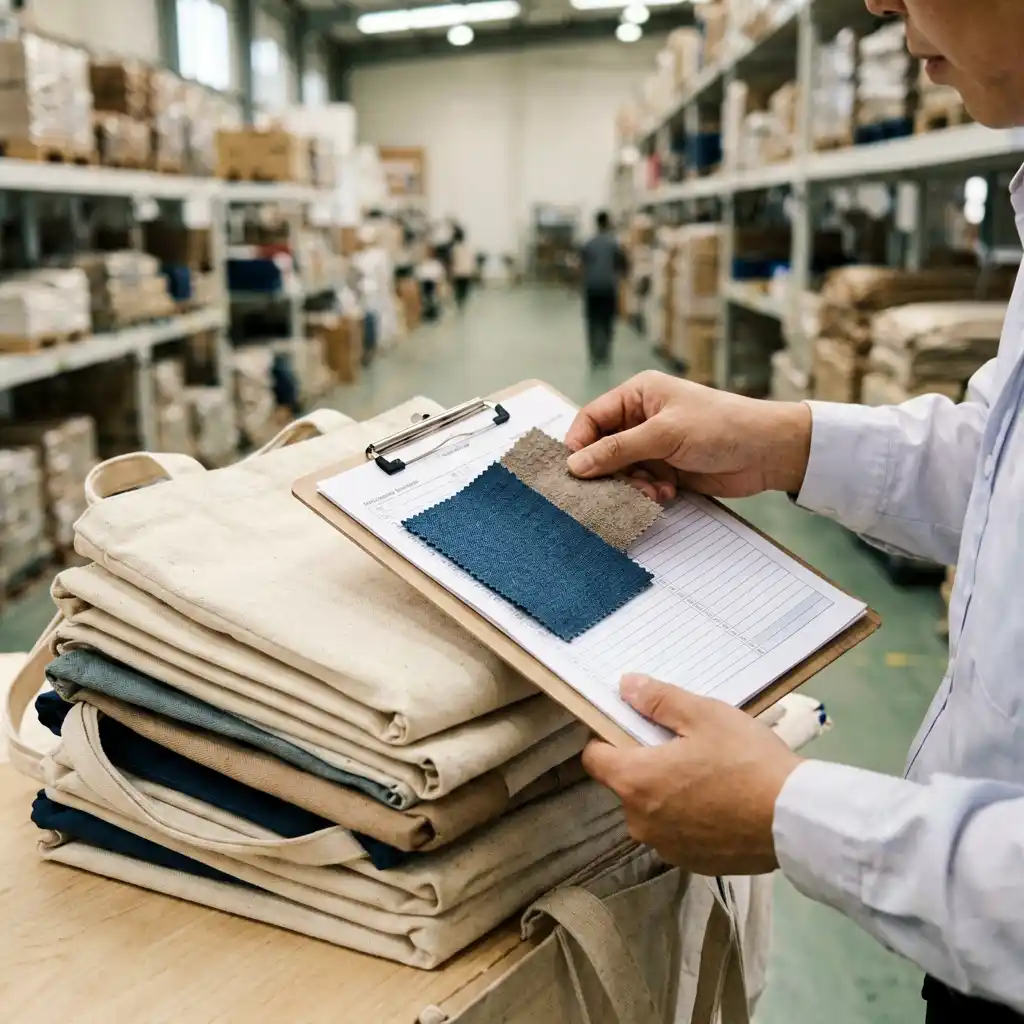
3. Request samples and test load capacity
Never approve production from photos alone. Order physical samples and put them through real-world abuse: load them with heavy items, wash them repeatedly, and inspect the stitching and handles. A bag that can’t survive your own stress test in your own hands won’t survive your customers.
4. Inspect the MOQ against your order size
Minimum order quantities are where inexperienced buyers get trapped — committing to thousands of units they can’t sell, or paying inflated per-unit prices for a tiny order. Understand the supplier’s MOQ and how it scales with your actual forecast. If you’re testing a new market, learn how a low-MOQ strategy lets you validate demand without betting the whole budget.
5. Clarify Incoterms and total landed cost
The unit price is only the beginning. Shipping, insurance, customs duties, and port fees can add 20-40% on top of what you think you’re paying. Agree on Incoterms (who owns the risk at each stage) and calculate the full total landed cost before you compare quotes — otherwise you’re comparing apples to oranges.
6. Ask for references and real client logos
Any factory can claim big-name clients. Ask for verifiable references — brands that will actually take your call or email — and look for logos that appear on real products, not just a collage on a sales page. Cross-check the supplier’s history on trade platforms and Google for red flags.
7. Agree on payment terms — never 100% upfront
This is the single most important rule in overseas sourcing. Never pay the full amount before production. Standard practice is a deposit (typically 30%) with the balance due after inspection or against shipping documents. For larger orders, use a letter of credit (L/C) or an escrow service so funds are only released when you confirm the goods.
8. Get a written spec sheet and production timeline
Verbal promises are worth nothing. Lock down every detail in writing: fabric type and weight, dimensions, handle style, stitching requirements, print placement and colors, packaging, and a firm production schedule with milestones. A written spec sheet protects you if the supplier delivers something different from what you agreed. Understand how long the whole process realistically takes with our custom bag production timeline guide.
Alibaba vs working with a factory directly
Where you find the supplier shapes how much vetting you need to do. Alibaba and similar marketplaces offer convenience and buyer-protection tools, but you’re usually dealing with a listing — which may belong to a trading company reselling another factory’s goods. Platform fees and a layer of middlemen eat into margins, and dispute resolution can be slow and painful.
Working directly with a factory cuts out the middleman, gives you direct access to the production team, and usually means better pricing and faster communication. The trade-off is that you own the due diligence yourself — which is exactly why the checklist above matters. Not sure which route suits your order size? Our guide to where to buy wholesale reusable bags compares the main channels side by side.
Before you commit, run a supplier through the same 15 questions we use with every B2B bag procurement partner.
Red flags to walk away from
Some signals should end the conversation immediately:
- No physical address — or an address that doesn’t match the business license.
- Pushy, outsized deposits — demanding 50% or more upfront is a classic scam pattern.
- Vague certifications — “we have certificates” with no numbers you can verify.
- Refusal to video-call — a real manufacturer will get on camera to show its facility and team.
If you see any of these, walk away. There are always other factories.
Vet the factory the way we’d want to be vetted
At Y Eco Bag, we believe a strong buyer-supplier relationship starts with radical transparency. We’re happy to walk you through our factory, share our certifications, send samples, and put everything in a written spec sheet — because that’s how trust is built. When you’re ready to compare a vetted partner against your shortlist, read about how we handle QC, browse our organic canvas totes, heavy-utility cotton totes with pockets, and woven PP promotional totes, explore our B2B services, or get in touch for a quote. We’ll help you source reusable bags — learn how our OEM/ODM manufacturing works before you brief suppliers. you can be proud to put your name on. For deeper planning, see our landed-cost guide and low-MOQ strategy.